Sunday, May 14, 2017

Bellarmine Ecosystem

Here is the Bell Ecosystem:


A producer
Plant the creates seeds
The habitat of this plant is simple. It creates by itself at the corner of Carney, surrounded by smaller, by smaller plants with the same job. This plants seems to flourish the most of all the plants in it's personal habitat.

A primary consumer
Chicken
The chickens live on our free ranged garden, eating various vegetation and flourishing in all of their functions.

Secondary Consumer and Tertiary Consumer
Human
The people roam around Bellarmine, eating whatever they want.

Decomposer
Fly
The flies fly around the entire campus, feeding on everything and dominating the campus. They mostly eat feces, food from the cafeteria, and corpses.


Herbivore
Honey Bee
They live in a bee habitat that is located in the garden. 

Carnivore
Fly
The flies fly around the entire campus, feeding on everything and dominating the campus. They mostly eat feces, food from the cafeteria, and corpses.


Omnivore
Human
The people roam around Bellarmine, eating whatever they want.

Threatened Species
Honey Bees
They live in a bee habitat that is located in the garden. 

Endangered Species
Chicken
The chickens live on our free ranged garden, eating various vegetation and flourishing in all of their functions.

Non-native species
Humans
Although humans only migrated to BCP in the 1800s, humans now roam around Bellarmine, eating whatever they want.

Pollution Source
Car
All of the cars are located in the various parking lots. They pollute the whole environment.

Discussion Questions:
1.  Environmental science is the over arching study of life sciences on Earth and their environments while ecology is the individual study of organism's interactions with one another in their specific environments. For example, environmental science at BCP is studying everything, including ecology, the meteorology, the seismology, and the geology. Meanwhile, ecology is simply what we studied today.

2.  The garden is a population that thrives using many biotic and abiotic factors. It has plants that use many abiotic factors including the sun, the carbon dioxide in the air, and the soil. Additionally, the chickens eat those plants, thus utilizing the biotic factors that are surrounding them. Then, the chickens poop out what they ate and the plant uses it.

3. 
4. The most endangered species on campus are the chickens in the garden. Because there is only a couple of chicken. It is scary because if only one or two die, there are none left to reproduce. Additionally, the bees are threatened because the do not have much flowers surrounding them. Once this source of life is gone, they will die off.

5. Pollution is the addition of unnatural masses to an environment. Cars, of course, add gases to Bellarmine with all of the emissions. That is the main pollution source on campus.


Thursday, May 11, 2017

Temperature Affecting Respiration Rate In Goldfish

The point of this lab was to analyze the relationship that respiration has to temperature of the environment.

Originally, since I had relatively no back information on this topic, my hypothesis was that the amount of breaths would go up when the temperature went down and the number of breaths would go up when the temperature went up.

It was a fairly simple lab. First, we put the fish into a container that was filled with was that was room temperature. We used Logger Pro to measure the temperature of the water. We counted the amount of breaths that our fish took while at room temperature. Then, we added ice cubes to the water. When the water was at 10-14 degrees Celsius, we counted the amount of breaths that the fish took. We repeated the same thing when the water was 5-10 degrees Celsius. Finally, we recorded our data and made conclusions.

Below I have included my data:

Table reflecting the effects that temperature has to respiration rate.


Graph describing the effects that temperature has on respiration ratr

My personal hypothesis was wrong. It turns out that when the temperature goes down the respiration rate goes down too. When the temperature goes up, the respiration rate goes up. This did not surprise me because when I thought about it, I do the exact same thing.


Analysis Questions:

1. Describe how the fish's respiration rate is affected by temperature. Be detailed.

As the temperature goes up, the respiration rate goes up. As the temperature goes down, the respiration goes down. Specifically, in our experiment this can be shown when our fish breathed 104 times in a minute at room temperature. Although, our fish breathed 53 times in a minute when the water was ten degrees colder.


2. What other factors may have affected the breathing rate?

Some other factors that may have affected the breathing rate are the amount of oxygen in the water, how much the water was moving, the density of the water, and the water pressure.


3. How did your fish compare to the average?

My fish was extremely close to the average, almost the exact same.


4. Why do scientists often take lots of data and look at the average? Why do you think you did that in this experiment?

Scientists take tons of data so that they can understand what the outliers are and make an accurate conclusion. By taking an average, you are seeing what all of the data looks like in a couple numbers that answer the question. We did that in this experiment for that reason.


5. Design an experiment that will test how a fish's respiration rate is affected by light. Explain your design below.

I would put the fish in an environment where there is a constant light. Then, I would use objects that lessen the amount of light, like a paper towel or paper, and use them to cove the fish. I would then count the amount of breaths and analyze.


6. Was your prediction at the beginning of the lab correct or incorrect?

My prediction was incorrect.


7. Propose an explanation for your experimental results. Why do you think fish react this way as their environmental temperature changes?

I think that it happened this way because oxygen is harder to obtain in the environment when the temperature gets hotter, making the fish breath more. I think that when it gets colder, oxygen gets easier to obtain for the fish, and it is able to breath less since it can get it easier.

Thursday, March 30, 2017

A Protein Composed of Carbs

I had number 25.

DNA Sequence:
3' to 5'

mRNA Sequence:
created 5' to 3'

AUG*GCU*AUG*AAU*UCU*UAG*CAU*AUU*UUU*UAG*CAU*GAU*UCU*UAG*CGU* UAG*GAA*GAU*AUG*AUG*GCU*UAG*UGU*CAU*AUU*UUU*UAG

Codon Dictionary Used:


Key:
Met or Start = Green
Alanine = Purple
Serine = Green with dots
STOP (Space) = White
Histidine = Orange
Isoleucine = Red
Proline = Yellow/Blue
Glutamic Acid = Pink
Cystein = Brown


          It was super cool to learn about science were you are not just taking notes, but applying it to something that you might eat! Transcription was the frustrating, time consuming part where you are taking lots of time and effort to ensure that every single letter is correct. If it is not correct, you likely have a mutation and have screwed up. Translation is a lot cooler, where you actually see the significance and the message behind all of the codes and letters. I now understand the process and the way it is viewed to a greater extent. I now feel like I know it well enough where I can teach it to somebody. 

Thanks Mr. Wong, 
Joe Sandoval

Thursday, February 9, 2017

DNA Extraction Lab

What did we do?
First, we filled a beaker with 5 ml of liquid dish washing detergent, 0.75 of salt, and 45 ml of distilled water. Next, we rinsed the strawberry, put it in a plastic baggie and mashed it a ton. Then, we ran the contents through a filter to remove the big chunks. The liquid content dripped into a test tube. We then added an equal volume of ice cold alcohol to the test tube and began to slowly twirl the tube. A murky thick bubbly substance rose to the top of the solution in the test tube. This thick bubbly substance was the DNA.

Why did we do what we did?
The original crushing of the strawberry was essential because it increased the surface area and began to break down the membranes that are protecting the DNA.
The extraction buffer served the role of further breaking apart the phospholipid membranes. Also, because of the negative charge of the DNA, the salt was able to go in and break down the super phosphate groups, and separate the DNA. Also, this makes it less soluble in water. Making it so that it does not want to be with the rest of the water.
I am not sure why the alcohol was added, but my hypothesis is that it contributed by somehow combining with the DNA and is less dense than water, therefore making it float.

I want to continue to research this to learn how exactly this works. Anyway, it was super cool that we were able to separate the DNA from a fruit that I an familiar with, and I look forward to learning more about the processes of DNA.


Sunday, February 5, 2017

Mitosis Lab

Here is the link to my worksheet. It has my image of each stage as well as the table. I will answer the questions on this blog:

Mitosis Lab Handout

1. It is more accurate to call mitosis "nuclear replication" because all of the steps involve the duplication of the DNA and does not really involve the splitting of any other organelles.

2.  These were selected for study because it is super easy to see the chromosomes in their cells and see what they are doing.

1. If I wasn't only looking at the top, there would be a lot more in interphase because that is where they are not really doing anything and are not trying to split. In the rest, they are not going to split, so it will be all interphase.

2. I can infer that each phase takes less and less time as it gets closer and closer to actually duplicating the DNA.

Sunday, January 29, 2017

What Is Cancer?

  1. How is a cancer cell different than a normal cell?
  2. How has cancer treatment evolved as scientists have learned more about cancer?
  3. What steps can an individual take to prevent cancer?
  4. Why has it been so difficult to find a cure for cancer?
  5. What does Richard Klausner mean when he says cancer is like evolution in a bottle?

1. A cancer cell is different from a normal cell because of it's ability to be constantly transforming and mutating to become more and more immune to the drugs that you are trying to use to treat it. It mutates much more than a normal cell.

2. Cancer treatment has evolved as they learn more because as we begin to figure out how a cancer cell tends to mutate, we have learned how to better plan ahead and know the cells next move so that we can find it's weaknesses and ultimately kill it.

3. There are obvious things that an individual can do to prevent cancer: don't smoke, drink in moderation, wear sunscreen, don't be exposed to radiation. But ultimately there is nothing that anybody can do to be completely immune to cancer because we don't know what causes 40% of cases of cancer.

4. It has been so difficult to find a treatment for cancer because the cell is constantly mutating and evolving. It is nearly impossible to treat something that is always rejecting what you are trying to use.

5. When he says that a cancer cell is like evolution in a bottle he means that there have been so many evolution in the world that have made it into what it is. Imagine all of those evolution in one compact space all happening at the same time. Now imagine that for eternity. That is what a cancer cell is like. That's what he is trying to say.

I am happy that we covered such a pressing topic in today's world and I look forward to learning more about cancer in the future.

Sunday, January 22, 2017

Cytoplasmic Streaming

First off, here is a link to a video that shows the chloroplasts moving inside of the elodea leaf cells.

Cytoplasmic Streaming

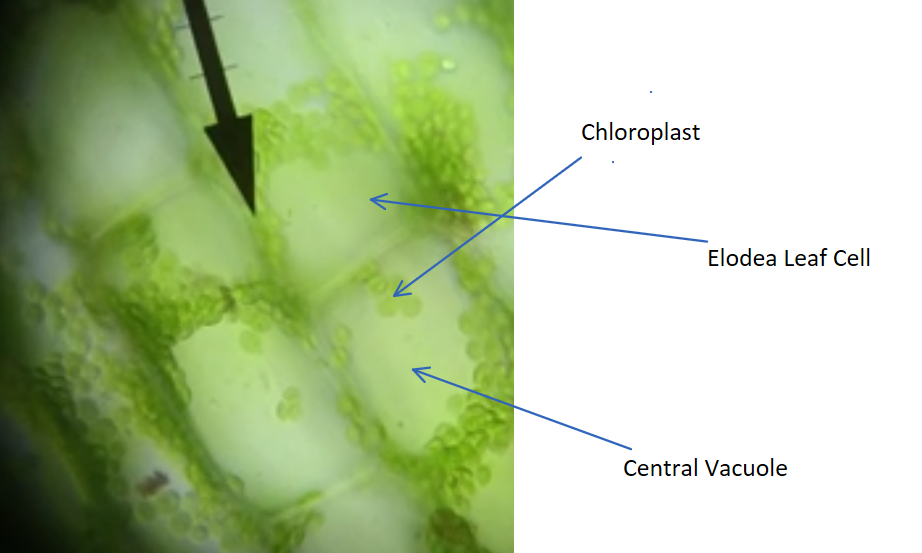
Additionally, here is a micrograph from when we looked at the elodea leaf cells on Tuesday.


What components of the cell theory were visible in the leaf?

          The part of the cell theory that you can really see in the video and the micrograph is that, as it states on page 156 of BSCS Biology: A Molecular Approach Ninth Edition, "Cells or products made by the cells, are the units of structure and function in organisms."
          When I first looked into our microscope and saw these images, I could not help but be astounded by how each cell fits together perfectly, creating the stability and structure that most plants have. It was super easy to see this due to the visible cell walls that set themselves apart by being extremely obvious to see.
          Something else that really stands out to me when I look at an image of these cells is how easy it is to hypothesize that the cells are filled with liquid (cytosol). I can tell that there is liquid inside of the cell because it is super easy for the chloroplasts to move and transport themselves from one spot to another.
          Finally, the last big thing that is easy to tell by looking at these images is that there is a central vacuole. We can tell that there is one in each of the cells because it is easy to notice that there are no chloroplasts in the middle of the cell. Instead they are pushed to the edges and are restricted to only moving near the cell wall.
          In conclusion, we can really learn a lot about cells by simply looking at them with a microscope and I look forward to being able to look further into cells.

Sunday, December 11, 2016

Thoughts on Bio Honors 12-9-16

          Honestly, that yesterday test was super hard. It was especially hard for me because I had a hard time focusing since I had just used most of my brain power on the test that I had had the previous period. The test that I had in math was a long test that was challenging, so I had put a ton of focus and effort into it. When I went into your class, I felt like my brain needed a break. It was so so so hard to focus, and I feel like I made at least a few stupid mistakes on that test.
          With the stress of finals starting to build, this test really didn't help at all. I was hoping that it would be an easier test so that I could have a better grade going into finals, but it was really quite the opposite. Although I have learned a ton of Biology in your class, it would be nice to get an A in your class, especially because it is an honors class, but that hope that I have been working for all semester is slowly drifting away. 
          I wish that I could just not care about my grades, and want to go to school to gain knowledge. I enjoy learning, because most of what I learn is fascinating, but the need to get good grades is always lingering in my brain, and I do not know what to do about it. Colleges look at grades, and it has be embedded in my brain that I need to get into a good college to be successful, and that thought is not going away any time soon. 
          What really frustrates me is the kids who can get good grades without working for them. Not to call anybody out, but there are some kids who do not even need to study and can get good grades without even trying. I train for sports 3 hours a day, and usually do homework or study until midnight, and then I get up at 6 every day, just to start it all over again. It is so unfortunate that grades have become what my generation strives for, but it is not going to change, I guarantee you that.
          Once again, thanks for giving me the opportunity to write these entries for extra credit. Thanks for helping me look deeper into myself. Thanks Mr. Wong!

Thoughts on Bio Honors 12-8-16

          In Bio today, you gave us a final lecture regarding cell respiration. You touched on Glycolysis, the Krebs Cycle, and you went in depth into the Electron Transport system. You also counted the amount of energy that cell respiration gets from food, and you proved to us that our bodies are super efficient in getting energy out off the food that we eat. Although we are super efficient, we could be even more efficient because some energy escapes as head, contributing to energy becoming more and more disorganized.

                                           Here are the notes that I took during class today.


          It continues to blow my mind that we know what happens inside these tiny cells. It is still incredible to me.

Tuesday, December 6, 2016

Thoughts On Bio Honors 12-6-16

          Today you taught me something bigger than Biology. Bigger than me. People must respect each other, or else they do not get along. To me, this theme goes right along with racism. The theme that we cannot get along due to disrespect or judging somebody by the color of their skin in my opinion is super similar. In both situations, this not getting along turns into something more, depriving others or success. With racism one act leads to the lack of confidence of one person, this leads to the lack of confidence in the people around them. These emotions spread contagiously to everybody around this person, ultimately leading to the deprivation of success for others. In our class, one students lack of respect almost turned into the entire class getting screwed over of the test and the extra credit.
          Although, I did learn one other thing, perhaps more important. If you are a man, and stand up for your actions, you can not only benefit yourself but others. I learned something huge today: we all mess up. Everyone does it. Famous men throughout history mess up. But you can always fix it if you stand up for it and show that you are owning up to it.

Mr. Wong, that lesson is so important to me. Thanks so much for teaching me. I'm not trying to kiss up to you right now, I promise, but you are the most influential teacher I have ever had. You have made me want to be a lawyer to fight for the rights of the people. Thank you, from the bottom of my heart.

I started doing these blog posts thinking that it would be some nice extra credit, but it has actually helped me look into myself.

Thoughts On Bio Honors 12-5-16

          The stuff that we learned today was super interesting. The fact that all of this stuff can go on inside a tiny cell continues to blow my mind on a daily basis. Millions of reactions every second, energy going into molecules and coming out of molecules. Every single day I am more and more interested. I love it.
          When you went more into depth into the Krebs Cycle, I realized for the first time, that whatever I put into my body has a real affect on how I feel, all the way down to a molecule approach. Every day, I have some junk food that lacks the elements that I literally need to survive and make get the energy that is essential to my daily functions.
          One question that I would have is what happens to the stuff that is in food that is not the stuff that goes into cellular respiration. Or does everything go in? How is it broken down and transported? I will ask this in class, but it was on my mind.
          I cannot say how much this still blows my mind. Literally I cannot wrap my mind around the fact that a little thing called an enzyme can put in energy into a bond and put an element onto a molecule. It is actually absolutely incredible. Most kids learn this stuff and they just look at it as more stuff. When I learn it, I think of it as a miracle from God, giving us life. One more time. incredible.

Sunday, December 4, 2016

Thought On Bio Honors 12-2-16

           On Friday, we addressed an extremely important subject: racism. At Bellarmine, we can say as much as we want about the diversity of our community, but at the end of the day, we do go to a private high school and we are privileged. Sometimes, when you are privileged, especially white men, you forget to take a step back and look at the different ethnicities of the other people around you and appreciate their culture.You just think about the false stereotypes that aren't even true. This continuous judging of people creates a constant separation between people. The question that comes to my mind, and makes me curious is, "Can we heal that separation? Or will it always be there, always lingering and depriving the people of the tight brotherhood we all crave?"
          After we had this discussion, which I value and think is essential that teenage privileged boys understand, I started thinking. Has my generation of white people come to the conclusion that we don't need Blacks, we don't need Latinos, we don't need Asians. They think that they can be successful without those groups of people. This is completely and utterly sad to me because I believe in a world where everybody uses one another's strengths and weaknesses to accomplish common goals. A world where everybody has mutual respect and love for one another. Although, you proved in class that this world is only a dream, because of the way that the children of tomorrow are being raised.

Thursday, November 3, 2016

Investigation 2C Lab Report

Investigation 2C Lab Report


           In this lab, we tested to see the rate of how fast the reaction with enzyme and hydrogen peroxide would create the product of oxygen. What we did was get a "reaction chamber" and put 4 stick 4 paper disks that had been previously soaked in enzyme to one side of it. We then tipped over the chamber so that the side with the disks was facing up. Next we poured 10 mL of hydrogen peroxide into the bottom of the chamber, so that it is not touching the enzyme. Next, we filled up a pan with water and we filled up a graduated cylinder with water. We then flipped the beaker over, so that it still filled with water, but is also upside down (it's mouth is in the pan of water. We then attached a cap to the reaction chamber that only lets gas out, and nothing in. Next we put the chamber into the pan of water, and flipped it over so that they hydrogen peroxide is touching the enzyme.  A reaction happened, letting bubbles go into the graduated cylinder. We did this two times, once with disks and once with three. For 10 minutes we measured how much gas went into the graduated cylinder. These bubbles are oxygen, a product of the reaction.
          We did this experiment so that my classmates and I could have a direct representation of a product of a reaction. My class is studying how organisms gain energy through what is released during a reaction and it was important that we understand how products are made. 


          As you can see by my table, my reactions gave off a ton of oxygen. With four disks of enzyme, and 10 mL of hydrogen peroxide, there was 18 mL of oxygen given off and with three disks of enzyme and 10 mL of hydrogen peroxide, there was 9 mL of oxygen given off. Before this experiment, I had no idea how much less dense gas is than liquid. This showcases it because the liquid goes from 10mL as a liquid, and then only a bit of that becomes 18mL of gas. This was absolutely mind blowing to me. Also, as you can see in my table, the enzyme reacts with the liquid as continuously as time goes on. Previously, I though that this reaction  was immediate. We later learned in class that eventually it would stop reacting because it would run out of materials. In conclusion, this experiment was interesting and taught me a lot. I am looking forward to more just like it in the future.

Sunday, October 2, 2016

Calibration of a Color pH Indicator Spectrum Lab Report

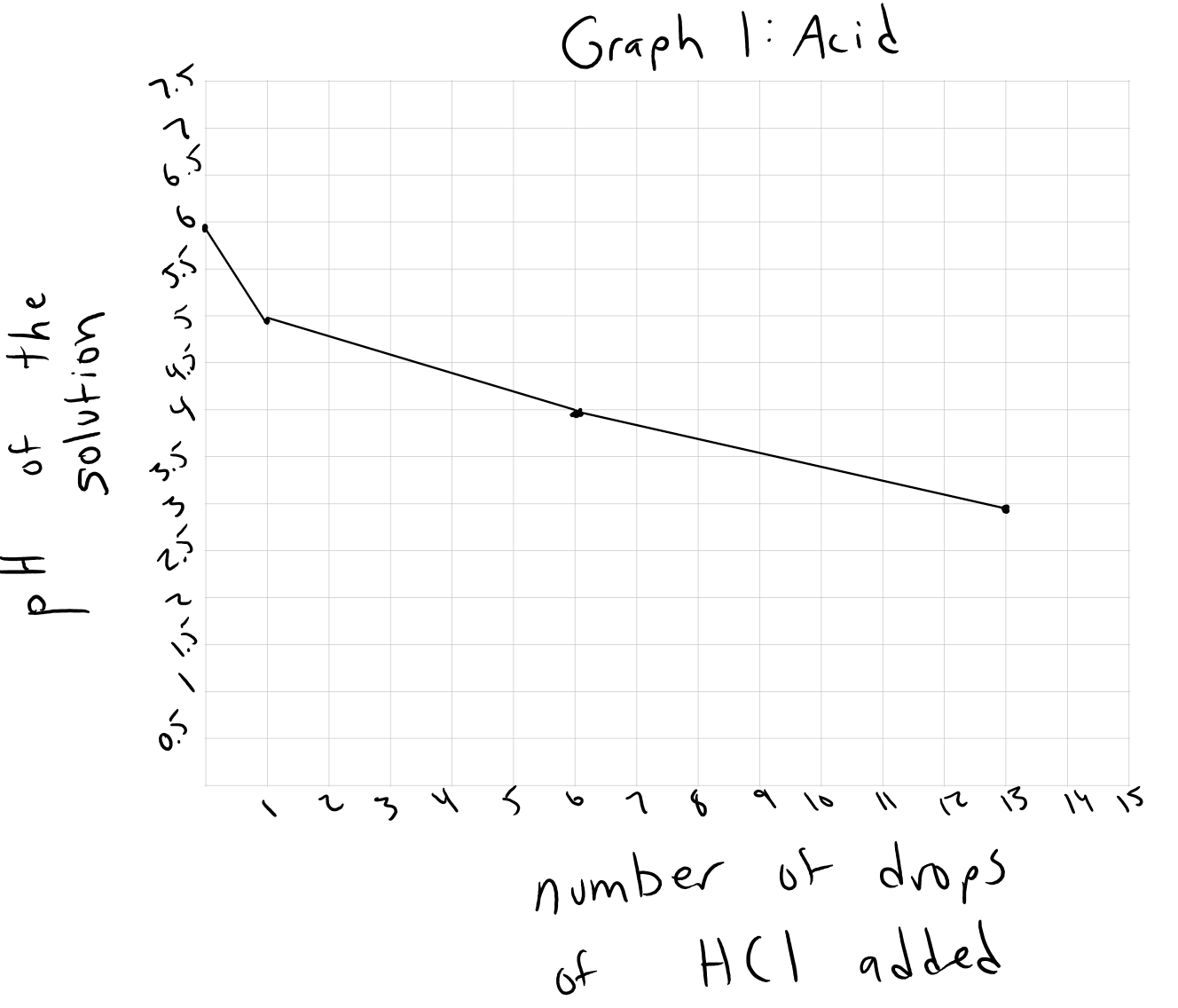
          On Friday, September 30th, we conducted a lab that focused on changing the pH of a beaker full of cabbage juice. First, we filled a beaker up to 100 ml and measured the pH of it. My group's probe measured that the pH of the juice was 5.8, as you can see from the table that I included below.


          Next, we were instructed to put in drops of Hydrochloric acid until the pH of our solution drops an entire whole number. It took our's a single drop to go down to a pH of 4.8. Then, we put 0.5 ml of the new solution into a test tube. We did the same process 2 more times. As you can see from the graph below, it took 5 more drops to get the liquid to a pH of 3.8 and 7 more drop after that for it to get to a pH of 2.8. In total, it took 13 drops to of Hydrochloric acid to get from a pH of 5.8 to a pH of 2.8.


          The third and final part of the lab asked us to do what we did with acid, except now with a base. We got 100 ml of cabbage juice that measured at a pH of 5.8. Then we added 7 drops of Sodium hydroxide for it to get to a pH of 6.8 and 6 more drops after that for it to get to 7.8. Finally, as you can see from the graph below, we added 13 more drops for our solution to have a pH of 8.8. We added 26 drops of Sodium hydroxide in total.


          As the picture below depicts, when the pH of the solution changed, so did the color of it. As we added more acid, the liquid became more of a red color, while as we added more base, the liquid became for of a blue/green color. If we ever wanted to know the pH of cabbage juice, we could use the photo below as an indicator to help us know that the pH is. The reason that we completed this lab was so that we could learn about how pH works and get more of a general feel for the affects of acids and bases so that when we go more in depth with pH it makes more sense. Now, next time we talk about pH, I will further understand the strength and efficiency that acids and bases have.


          The first thing that really blew my mind about this lab was the sheer number of hydrogen ions and hydroxide ions that were in a few drops of liquid. When I realized that there were millions of ions packed into each drop, my jaw fell to the floor. As you can see in "Table 2: Acid" above, there were .0001 times 10 to the negative third power moles of hydrogen ions. That is a lot of molecules. Something else that was fascinating to me was the affect that so little acid had. Originally, we had 100 ml of cabbage juice. Each drop was about 0.5 ml. We only put one drop of acid, as the table shows, and it changed the solution by a whole pH. That is incredible. In conclusion, this lab greatly improved my knowledge of pH, and I am looking forward to more labs in the future.


Monday, August 29, 2016

Problems With Science

     Personally, I think that the biggest problem in science today is not thinking openly. Scientists today say "that is impossible" rather than trying to figure out a way to make it work. This especially applies to space travel, a subject that particularity interests me. Instead of trying to figure out if we are alone or not, scientists have given up on going beyond our Solar System. I believe that there is a way to accomplish anything, even if it does not initially seem possible. Obviously, the science community disagrees with me. The following links are examples of this closed minded way of thinking:
   Another problem that I see with science today is the lack of help to our Earth. In my opinion, as of now, Earth is our only place that we can live at. And based off of how important it is to us, we do not treat it nearly okay. Science needs to solve problems including global warming and we need to learn how to eliminate waste. If we do not start to focus on these problems, there will not be an Earth for our future generations to live on.